There’s a particular kind of frustration that only people living below someone else truly understand. It’s 11 p.m., you’ve finally settled in, and then it starts — the slow, deliberate thud of footsteps overhead, a chair scraping back, maybe a bass line bleeding through the slab. You’re not asking for silence. You’d just like your ceiling to stop broadcasting your neighbour’s evening routine into your living room.
Apartments and studios are where ceiling noise hits hardest, because the floor above you is someone else’s floor, and sound travels straight down through the structure. For a music producer or podcaster, the problem flips — you’re the one trying to keep sound in, so it doesn’t leak to the flat above or the street below.
The good news is that a ceiling can be tamed. The slightly less good news is that most of the “quick fixes” floating around the internet — egg cartons, a few foam tiles, a thick rug upstairs — barely move the needle on the kind of noise that actually keeps you awake. This guide walks through the best soundproof ceiling ideas for apartments & studios that genuinely work, how they work, what they cost you in ceiling height and budget, and where each one fits best.
First, Understand the Noise You’re Actually Fighting
Before throwing materials at a ceiling, it helps to know what you’re up against. Get this wrong and you’ll spend money treating the wrong problem.
Airborne Noise vs Impact Noise
Airborne noise is sound travelling through the air before it hits a surface — voices, television, music, a barking dog. It vibrates the ceiling, which then re-radiates that sound into your room.
Impact noise (also called structure-borne noise) is created by something physically striking the structure — footsteps, dropped objects, dragged furniture, heels on a tiled floor. This is the harder enemy. The vibration travels through the building’s bones, and no amount of soft surface inside your room will stop it on its own.
Most apartment ceiling complaints are an unhappy mix of both, with impact noise being the one people underestimate.
The Numbers That Matter: STC and IIC
Two ratings tell you how a ceiling assembly performs. STC (Sound Transmission Class) measures how well an assembly blocks airborne sound — higher is better. IIC (Impact Insulation Class) measures how well it controls impact noise from above. When you’re comparing systems or reading a product’s test data, these are the figures to look for, not vague marketing words like “acoustic.”
Soundproofing is Not Acoustic Treatment
This is the single biggest source of wasted money in this field, so it’s worth being blunt about. Soundproofing means stopping sound from getting in or out of a room. Acoustic treatment means controlling how sound behaves inside the room — reducing echo and reverberation. Foam panels and acoustic clouds make a room sound better; they do almost nothing to block your neighbour’s footsteps. You need the right tool for the right job, and often you need both.
The Four Principles Every Soundproof Ceiling Relies On
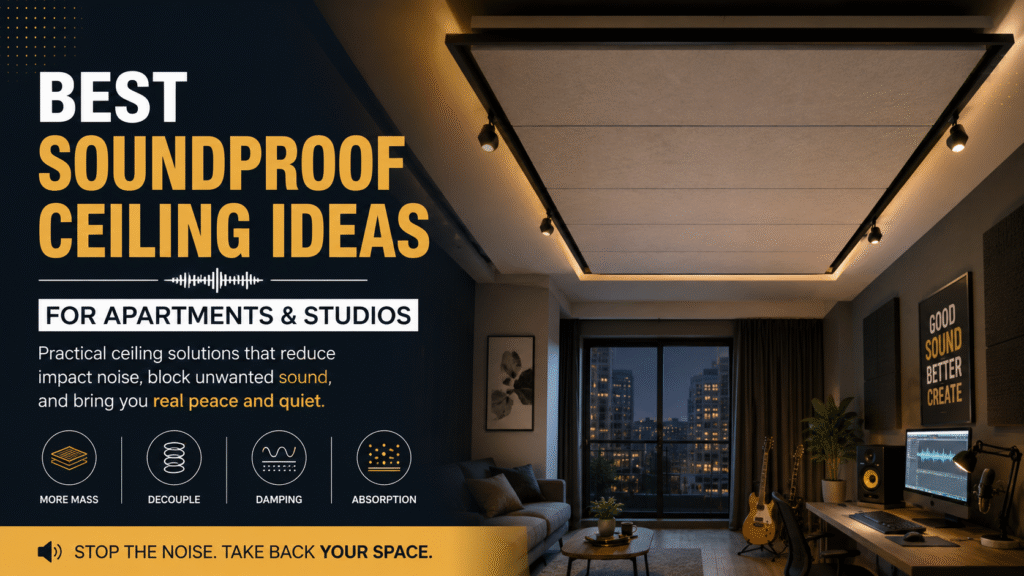
Every effective ceiling solution, no matter how it’s branded, leans on some combination of four principles.
- Mass. Heavy, dense surfaces are harder for sound to vibrate through. Adding mass is the most basic way to improve a ceiling.
- Decoupling. If the ceiling layer is rigidly attached to the joists above, vibration passes straight through. Decoupling breaks that direct path so sound can’t travel as easily. This is the key to fighting impact noise.
- Damping. A damping layer between two boards converts sound vibration into tiny amounts of heat, killing the energy before it crosses.
- Absorption. Soft material inside the cavity (like mineral wool) absorbs sound energy bouncing around in the air gap.
A fifth, unglamorous factor sits over all of these: air-sealing. Sound leaks through gaps the way water leaks through a cracked pipe. A beautifully built ceiling with unsealed light fittings and edges will disappoint you.
Best Soundproof Ceiling Ideas That Actually Work
Here are the approaches we recommend most often, roughly from simplest to most serious.
Add a Second Layer of Mass
The most straightforward upgrade is a second layer of dense board — typically gypsum — beneath the existing ceiling. More mass means less vibration passing through. On its own it’s a modest improvement for airborne noise and not much for impact, but it’s the foundation that other techniques build on.
Decouple with Resilient Channels or Isolation Clips
This is where real impact-noise control begins. Instead of fixing the new ceiling board directly to the joists, you mount it on resilient channels or, better still, sound isolation clips with furring channels. These create a small, springy gap that interrupts the vibration path. A decoupled ceiling is dramatically better at handling footsteps and structure-borne thumps than a directly fixed one. The trade-off is that it drops your ceiling height slightly and demands careful installation — done sloppily, a single screw touching the joist can short-circuit the whole system.
Add a Damping Layer Between Boards
Sandwiching a viscoelastic damping compound between two layers of board turns the assembly into a far better sound barrier than the same boards stacked plainly. It’s an inexpensive add-on with a surprisingly large payoff, especially for music and low-frequency noise.
Fill the Cavity with Mineral Wool
The air gap above your new ceiling shouldn’t be left empty. Packing it with mineral wool or rockwool absorbs sound resonating in the cavity and improves both STC and IIC. It’s cheap, it’s effective, and it doubles as thermal insulation.
Mass Loaded Vinyl (MLV)
MLV is a thin, heavy, flexible sheet that adds serious mass without much thickness. Layered into a ceiling build-up, it boosts airborne sound blocking where ceiling height is too precious to lose. It’s a specialist material — useful, but rarely a standalone fix.
Suspended Acoustic Ceiling Systems
A suspended grid ceiling with acoustic tiles is a clean, practical option for offices and commercial spaces. It’s excellent for absorbing in-room noise and reducing echo, and the plenum above gives room to run services. For pure sound blocking between floors it’s moderate rather than mighty, but combined with insulation and good ceiling-to-ceiling detailing it earns its place.
Acoustic Panels and Ceiling Clouds (for Treatment)
For studios and home theatres, suspended acoustic clouds and panels control reflections directly above the listening or recording position. To be clear, this is treatment, not isolation — it makes recordings cleaner and rooms less echoey, but won’t keep sound from leaving the room. In a studio you almost always want this on top of a proper isolation build-up.
Seal Every Gap
Acoustic sealant around the ceiling perimeter, around recessed lights, and at every penetration is the cheapest high-impact step you can take. Treat air gaps as the enemy. This is the detail amateurs skip and professionals obsess over.
The Floating or Room-in-a-Room Ceiling (Studio-Grade)
For serious recording studios, the gold standard is full decoupling — a ceiling hung on dedicated isolation hangers, sometimes as part of a complete room-in-a-room build. It’s the most effective option by a distance, and also the most expensive and space-hungry. This is engineered territory, not a weekend project.
Soundproof Ceiling Ideas by Space
The right combination depends entirely on the room.
Apartments and Residential Homes
Most apartment dwellers are fighting impact noise from above and can’t rebuild the whole structure. The realistic sweet spot is a decoupled ceiling on isolation clips, a double board layer with damping compound, and a mineral-wool-filled cavity, all properly sealed. Renters with limited freedom get less dramatic but still useful results from acoustic panels and absorption — just keep expectations honest about what they can and can’t do.
Recording and Music Studios
Studios need both jobs done: isolation so sound doesn’t escape, and treatment so the room sounds accurate. That means a decoupled, mass-loaded, sealed ceiling for soundproofing a studio ceiling properly, plus acoustic clouds and panels inside for reflection control. Skipping the isolation and only adding foam is the classic beginner mistake.
Home Theatres
A home theatre ceiling has to contain loud, bass-heavy sound while controlling reflections for clean dialogue and surround imaging. Decoupling and mass handle the low-frequency leakage; acoustic clouds above the seating handle the in-room reflections. Bass is the toughest frequency to contain, so a home theatre ceiling rewards a generous, well-engineered build-up.
Offices and Commercial Spaces
Open-plan offices usually care more about reducing distracting in-room noise and speech travel than about blocking neighbours. Suspended acoustic ceilings with high-NRC tiles, sometimes with added mass over meeting rooms for confidentiality, do the job well.
Educational Institutions
Classrooms, libraries, and music rooms each have different needs — speech clarity in classrooms, quiet in libraries, isolation in music rooms. Acoustic ceilings tuned for absorption improve learning environments, while music and AV rooms benefit from proper isolation build-ups.
Auditoriums
Auditorium ceilings are a designed acoustic surface, balancing absorption, reflection, and isolation from the outside world. These are bespoke, engineered systems where the ceiling is part of the room’s overall acoustic plan rather than an afterthought.
Expert Tips from the Field
A few hard-won pointers we share with almost every client:
- Treat impact noise as a separate problem. If footsteps are your issue, mass alone won’t save you — you need decoupling. This is the mistake we correct most often.
- Don’t confuse foam with soundproofing. Acoustic foam controls echo. It does not block your neighbour. If someone sells you foam as a soundproofing solution, walk away.
- Air-seal obsessively. A 1% gap can undo a large share of an assembly’s performance. Sealant is cheap insurance.
- Respect your ceiling height. Every decoupling and mass layer costs you headroom. Plan for it before you start, especially in apartments with low slabs.
- Mind the flanking paths. Sound also travels around the ceiling — through walls, columns, and shared structure. A perfect ceiling can be undermined by an untreated flanking route, so think about the room as a whole.
- Look at the test data. Ask for STC and IIC figures from real assembly tests before committing to a system. Numbers beat adjectives.
- Match ambition to budget honestly. A modest improvement done well beats an over-promised system done badly. Tell your installer your real goal and your real budget.
Frequently Asked Questions
Can you really soundproof an apartment ceiling without rebuilding it?
You can significantly improve it. A decoupled ceiling with added mass, damping, cavity insulation, and good sealing makes a big difference. Full silence is rarely achievable in a shared building, but a well-designed ceiling can transform livability.
What’s the best way to block footsteps from upstairs?
Decoupling is the key. Isolation clips or resilient channels break the vibration path that carries impact noise, and they outperform simply adding mass. Ideally combine decoupling with mass and cavity insulation.
Does acoustic foam soundproof a ceiling?
No. Foam absorbs sound inside a room and reduces echo, but it does not block sound travelling between floors. It’s useful for treatment, not isolation — two different jobs.
How much ceiling height will a soundproof ceiling cost me?
It varies with the system, but decoupled and multi-layer ceilings typically lower the ceiling by a few inches. It’s worth planning for this early, particularly in apartments with limited height.
What’s the difference between soundproofing and acoustic treatment?
Soundproofing stops sound entering or leaving a room. Acoustic treatment controls how sound behaves inside the room. Studios usually need both; a noisy apartment usually needs soundproofing.
Are suspended acoustic ceilings good for blocking noise?
They’re excellent for absorbing in-room noise and echo, and good for offices and commercial spaces. For strong floor-to-floor sound blocking, they need to be combined with insulation and proper detailing rather than relied on alone.
Is it worth soundproofing a rented apartment?
It depends on your freedom to modify the space. Non-invasive options like acoustic panels offer modest help, while a full decoupled ceiling needs landlord permission. Be realistic about results before investing in a rental.
Conclusion
The best soundproof ceiling ideas for apartments and studios all come back to the same handful of principles: add mass, decouple the structure, damp the vibration, absorb the energy in the cavity, and seal every gap. Get those right, in the right combination for your space, and even a noisy upstairs neighbor or a loud monitor mix can be brought under control.
What matters most is matching the solution to the actual problem — impact noise needs decoupling, in-room echo needs treatment, and a serious studio needs both, engineered properly. Skip that diagnosis and you’ll spend money chasing the wrong fix.