Here’s a scenario we see more often than we’d like. An architect specifies a premium acoustic ceiling panel — the datasheet proudly says NRC 0.90, the highest-rated product in the range. The space gets built, the client moves in, and the atrium still echoes like a railway tunnel. Everyone’s confused, because surely the best panel should have solved it?
The uncomfortable truth is that specifying acoustic ceiling panels for a big, open space is not the same as picking the product with the biggest number on the box. A large-volume space — a double-height office, an atrium, a lecture hall, a mall concourse — is a genuinely different acoustic ceiling problem from a normal room, and it punishes lazy specification. An effective acoustic ceiling solution requires more than selecting a high-NRC panel; it demands the right combination of absorption performance, coverage area, mounting strategy, and room-specific acoustic design. Too little absorption, the wrong frequency behaviour, the wrong mounting, or simply not enough coverage, and the most expensive panels in the catalogue will disappoint you.
This guide walks through how to actually specify acoustic ceiling panels for large open volumes — the way an acoustician approaches it. We’ll cover defining the goal, reading the numbers properly, choosing the right system, calculating coverage, and the practical constraints that trip people up. It’s a bit more technical than usual, but if you’re an architect, designer, or facility manager, this is the stuff that saves projects.
Why Large-Volume Spaces Are So Hard to Get Right?
The core issue is volume. The amount of sound-absorbing material a space needs is tied to how big it is — pack more air into a room and you need proportionally more absorption to keep the reverberation under control. Large open spaces also tend to be wrapped in hard, reflective surfaces like glass, concrete, and stone, and they’re frequently open-plan, so there are no partitions to break up the sound.
Put simply: a big empty box of a space is the hardest acoustic environment to tame, and the ceiling — usually the largest single surface available — has to carry much of that burden. Specifying it well means treating it as an engineering problem, not a shopping decision.
Step 1 — Define the Acoustic Goal Before the Product
The single most common mistake is choosing a panel before defining what success looks like. Always start with the goal.
What Is the Space Actually For?
Different uses want different acoustics. Spaces built for speech—such as open offices, lecture halls, and call centers—need a short, controlled reverberation so words remain crisp and intelligible. In environments designed for comfort, including malls, lobbies, and restaurants, the priority is reducing noise build-up to lower the overall din. Performance venues and music spaces, on the other hand, benefit from a richer, carefully tuned acoustic response that enhances the listening experience.Nail down the primary function first; it drives everything downstream.
Set a Target Reverberation Time
The headline target is usually reverberation time (RT60) — how long sound takes to decay by 60 decibels. Speech-focused spaces typically want a shorter RT, performance spaces a longer one, with published guidance for different building types to aim at. For spaces where understanding speech is critical, you might also consider STI (Speech Transmission Index) as a more direct measure of intelligibility. The point is to put a number on the goal before you look at a single product.
Step 2 — Understand the Numbers on the Spec Sheet
Once you have a target, you can read panel data properly — and “properly” means going beyond the single headline figure.
Sound Absorption Coefficient and Frequency
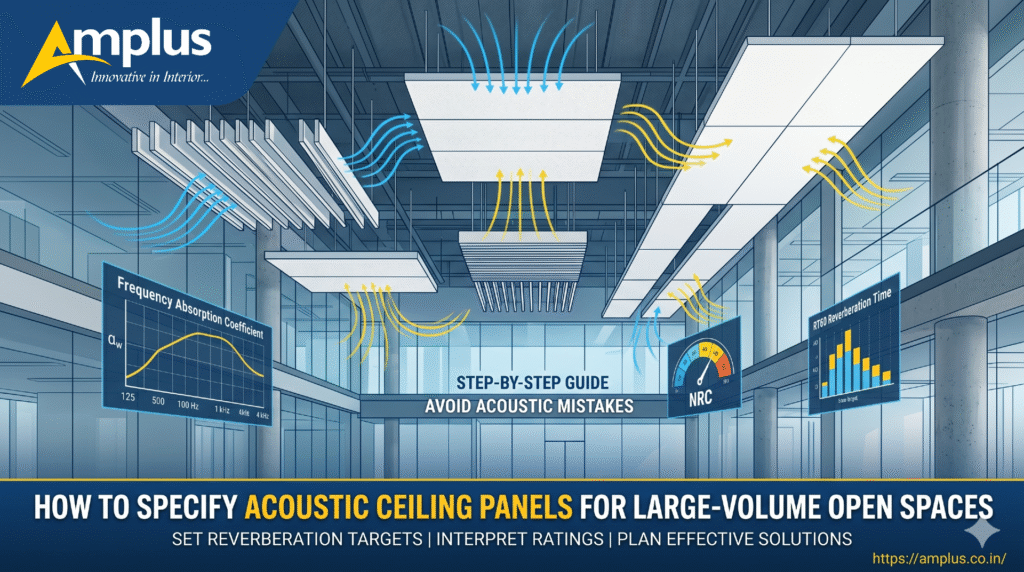
The real performance data is the sound absorption coefficient (α) measured across frequency bands, typically 125 Hz to 4 kHz. A coefficient near 1.0 means almost total absorption at that frequency; near 0 means reflection. What matters is the shape of that curve. Many panels absorb high frequencies beautifully but fall away in the low end — and if your problem is low-frequency rumble, a great high-frequency number won’t help you. Always look at the full frequency table, tested to a recognised standard such as ISO 354 or ASTM C423.
NRC vs αw — and Why a Single Number Can Mislead
Two single-number ratings summarize that curve. NRC (Noise Reduction Coefficient) averages absorption across the mid frequencies. αw (weighted sound absorption coefficient), defined in ISO 11654, gives a single value and an absorption class from A (highest) down to E, sometimes with shape indicators flagging strong low-, mid-, or high-frequency behaviour.
Both are useful shorthand, but both hide the frequency detail. A high NRC tells you a panel absorbs well on average — it doesn’t tell you it handles the specific frequencies your space struggles with. Use the single number to shortlist, then check the full curve before you commit.
How Much Absorption Do You Actually Need?
This is where large volumes bite. The relationship between volume, absorption, and reverberation is captured by the Sabine equation — in essence, the bigger the room volume, the more total absorption (measured in sabins) you need to hit a given reverberation time. Total absorption is the sum of every surface’s area multiplied by its absorption coefficient. For a large space, that means you often need a lot of effective absorbing area, and a modest patch of high-NRC panels simply won’t move the needle. Running this calculation — even roughly — early on tells you whether your ceiling solutions can do the job alone or whether you’ll need walls and baffles too.
Step 3 — Choose the Right System for the Volume
With the target and the numbers understood, you can pick a system that fits the space, not just the budget.
Continuous Ceiling vs Baffles, Rafts and Clouds
A continuous suspended acoustic ceiling works well where you have a defined ceiling plane at a reasonable height. But in tall, open, or exposed-structure volumes, suspended baffles, rafts, and clouds are often far more efficient. Because they hang free, both faces absorb sound, and they can be positioned closer to the noise and people below. For a high atrium or an exposed-services warehouse-style office, discontinuous absorbers frequently deliver more performance per square meter than a flat ceiling stretched across the top.
Mounting and Plenum Depth
Here’s a detail that quietly wrecks specifications: how a panel is mounted changes its measured performance. Lab absorption figures are tested under a specific mounting condition (referenced by mounting types), and an air gap or plenum behind the panel boosts low-frequency absorption significantly. A panel fixed tight to a hard surface performs very differently from the same panel suspended with a deep cavity behind it. Always check that the tested mounting matches how you’ll actually install it — otherwise the real-world result won’t match the datasheet.
Step 4 — Plan Coverage and Placement
Even the right panel fails if there isn’t enough of it, in the right places. In large volumes you generally need substantial coverage, not a token gesture. Distribute the absorption rather than clustering it, prioritize surfaces near reflective hard finishes and near the main noise sources, and accept that the ceiling alone may not be enough — in really large or reflective spaces, wall absorption or additional baffles are part of the answer. Specifying acoustic ceiling panels for these spaces is as much about quantity and placement as it is about product choice.
Step 5 — Don’t Forget the Practical Constraints
Acoustics share the ceiling with everything else, and a specification that ignores the practical realities gets value-engineered or redesigned later. Build these in from the start:
Fire performance must meet the requirements for the building category. Weight and the suspension system must be specified for the load, with structural and, in some regions, seismic fixing considered. Lighting, HVAC, sprinklers, and AV all live in the same plane, so coordinate them early. Maintenance and cleanability matter in public and healthcare spaces. Light reflectance affects how much daylight bounces around and your energy use. And increasingly, sustainability — recycled content and recognised certifications — is a spec requirement, not an extra. Good specification balances the acoustic target against all of these honestly.
Conclusion
Specifying acoustic ceiling panels for large-volume open spaces is an engineering exercise, not a catalogue pick. Define the acoustic goal and a target reverberation time first. Read the full frequency data, not just the headline NRC. Estimate how much total absorption the volume actually demands. Choose between a continuous ceiling and free-hanging baffles based on the space. Plan enough coverage in the right places, match the tested mounting to reality, and build in fire, weight, services, and sustainability from the start.
Do that, and the ceiling delivers the calm, clear, comfortable space the design promised. Skip it, and even a 0.90-NRC panel can leave you standing in an echoing room wondering what went wrong. The number on the box was never the whole story.
Frequently Asked Questions
What’s the most important number when specifying acoustic ceiling panels?
There isn’t a single one. Start with a target reverberation time for the space, then check the panel’s full frequency absorption data rather than relying only on its NRC or αw. The single-number ratings are useful for shortlisting, not final decisions.
What is the difference between NRC and αw?
NRC (Noise Reduction Coefficient) averages absorption across mid frequencies, while αw (weighted sound absorption coefficient, to ISO 11654) gives a single value plus an absorption class from A to E. Both summarize performance but hide the frequency detail you should still review.
Why doesn’t a high-NRC panel fix my echoey atrium?
Large volumes need a large total amount of absorption, and a high rating on a small area can’t supply it. The mounting may also differ from the test condition, and the panel may underperform at the frequencies causing the problem. Coverage, placement, and frequency behaviour all matter.
Are ceiling baffles or a flat ceiling better for tall open spaces?
In tall or exposed-structure volumes, suspended baffles, rafts, and clouds are often more efficient because both faces absorb sound and they sit closer to the noise. A continuous ceiling suits spaces with a defined ceiling plane at a sensible height.
Does the way a panel is installed affect its performance?
Yes, significantly. Absorption is tested under a specific mounting condition, and an air gap or plenum behind the panel improves low-frequency absorption. Always match the tested mounting to your real installation, or the result won’t match the datasheet.
Do I need to treat the walls as well as the ceiling?
Often, yes. In large or highly reflective spaces, the ceiling alone may not provide enough absorption to hit your target. Adding wall panels or baffles is frequently part of a complete solution.
Which standards should acoustic panel data be tested to?
Look for sound absorption tested to ISO 354 or ASTM C423, with classification under ISO 11654 for αw. Always ask for tested figures for the complete system and mounting you intend to use.