When designing a modern office, meeting room, or commercial space, managing noise is a critical priority. However, one of the most common mistakes facility managers make is using “soundproofing” and “acoustic treatment” interchangeably.
While both relate to noise control, they solve entirely different problems using different materials. Installing acoustic ceiling tiles won’t stop heavy traffic noise, just as building a dense concrete wall won’t fix a frustrating echo inside a conference room.
Understanding the fundamental distinction between sound isolation and sound absorption is essential for specifying the right materials and creating a comfortable environment.
What Is Soundproofing?
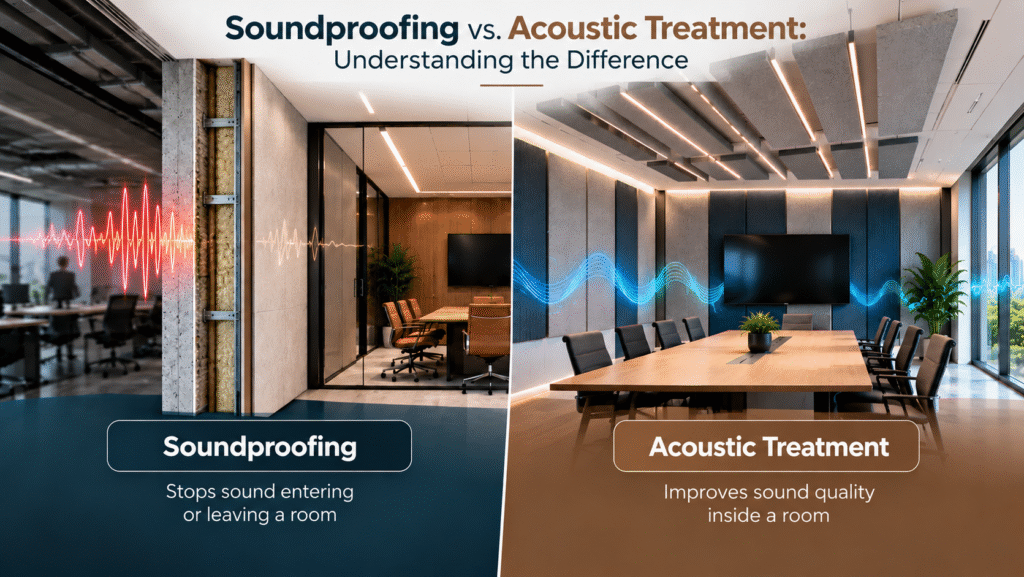
Soundproofing—or sound isolation—is the structural process of preventing sound waves from travelling between two separate spaces. Its primary objective is to block airborne noise (like voices) and structure-borne impact noise (like footsteps) from entering or leaving a room.
If you need to prevent HR conversations from leaking into the hallway, you need soundproofing. This relies on heavy, construction-level modifications based on three principles:
- Mass: Using heavy materials like mass-loaded vinyl (MLV) to create a barrier.
- Decoupling: Physically separating building structures to stop vibrations.
- Airtight Sealing: Eliminating flanking paths. Sound leaks through the smallest gaps around doors and vents.
Soundproofing effectiveness is measured using the Sound Transmission Class (STC). A higher STC indicates superior sound-blocking.
What Is Acoustic Treatment?
Acoustic treatment improves the sound quality inside a room. It does not prevent sound from escaping; it controls how sound waves behave after being generated.
In rooms with hard, reflective surfaces like glass walls and bare ceilings, sound waves bounce repeatedly. This uncontrolled reflection creates reverberation and echo, degrading speech intelligibility and making the environment fatiguing. Acoustic treatment corrects this through:
- Sound Absorption: Using porous materials—such as mineral fibre ceiling tiles or fabric-wrapped panels—to absorb sound energy rather than reflecting it.
- Diffusion: Scattering sound waves evenly to eliminate harsh echoes without deadening the room’s natural acoustics.
Acoustic treatment materials are evaluated using a Noise Reduction Coefficient (NRC). An NRC rating ranges from 0 to 1.0; a higher number means greater sound absorption. A material with an NRC of 0.85 absorbs 85% of the sound that hits it. A properly treated space creates a balanced, professional acoustic environment where communication is effortless.
Soundproofing vs. Acoustic Treatment: Key Differences
The core difference lies in the ultimate goal: soundproofing stops sound travel, while acoustic treatment controls sound behaviour.
Soft furnishings, carpets, and decorative acoustic panels are excellent for acoustic treatment, but practically useless for soundproofing. Conversely, a perfectly soundproofed room will keep out all external noise, but the internal echo might make having a conversation nearly impossible.
Comparison Table
| Feature | Soundproofing (Sound Isolation) | Acoustic Treatment (Sound Absorption) |
| Primary Goal | Stop sound entering or leaving a room | Improve sound quality inside a room |
| Noise Type Addressed | Airborne transmission & structure-borne impact | Internal reverberation, echo, and flutter |
| Typical Materials | Drywall, Mass-Loaded Vinyl (MLV), isolation clips | Mineral fibre ceiling tiles, acoustic foam, diffusers |
| Key Metric | Sound Transmission Class (STC) | Noise Reduction Coefficient (NRC) |
| Application Style | Structural modifications, within walls/floors | Surface-mounted on ceilings or walls |
Which Solution Does Your Space Need?
Selecting the right acoustic strategy depends on diagnosing the actual noise problem.
When You Need Soundproofing: Invest in sound isolation if your main issue is external interference or privacy. Common applications include:
- Keeping heavy street traffic out of boardrooms.
- Preventing sound transmission between adjoining hotel rooms.
- Isolating private executive offices.
When You Need Acoustic Treatment: If the noise problem originates within the room itself, acoustic treatment is the solution. Common applications include:
- Open-plan offices suffering from background chatter.
- Shopping malls, airport lobbies, and restaurants that sound excessively chaotic.
- Meeting rooms where participants struggle to hear clearly over video calls.
For these interior spaces, integrating sound-absorbing elements—like Mineral Fibre Ceiling Tiles, Gypsum Perforated Ceilings, or Metal Baffles—can drastically reduce reverberation time and enhance ambient comfort.
Can Soundproofing and Acoustic Treatment Work Together?
Yes. Premium commercial spaces often require a combination of both to achieve optimal acoustics.
Soundproofing creates a controlled “blank slate” by blocking external interference. Once isolated, acoustic treatment acts as the final polish, shaping internal acoustics for clarity and focus.
For instance, a modern presentation centre might feature decoupled walls and heavy doors to keep lobby noise out (soundproofing), alongside an elegantly suspended Open Cell Ceiling to eliminate internal flutter echoes and enhance aesthetic appeal (acoustic treatment). Addressing both ensures your space is completely optimized for comfort and productivity.
Conclusion
Failing to distinguish between sound isolation and sound absorption is a costly error in interior architecture. Accurately identify whether you need to block noise from travelling or simply improve audio clarity within the space.
If your goal is to enhance internal acoustics, Amplus offers a premium range of scientifically designed ceiling systems. From high-NRC mineral fibre tiles to aesthetic metal baffles, exploring the right architectural ceiling can completely transform how your space sounds and feels.
Frequently Asked Questions (FAQs)
Can acoustic panels soundproof a room?
No. Acoustic panels absorb sound to reduce echo inside a room, but they lack the mass and density required to block sound from passing through walls.
What is the cheapest way to soundproof an office?
True soundproofing requires structural changes, but sealing air gaps around doors, windows, and vents with acoustic caulking is the most cost-effective first step to reduce noise transmission.
Does a suspended acoustic ceiling help with soundproofing?
A suspended ceiling equipped with mineral fibre tiles is highly effective for acoustic treatment (reducing echo). While it offers minor sound-blocking benefits by adding an air gap, it is not a standalone soundproofing solution for stopping loud impact noise from the floor above.