Everyone judges a suspended ceiling by the tile. They’ll debate the texture, the colour, the acoustic rating of the panel for hours — and barely glance at the metal grid holding it all up. Which is a bit like obsessing over the upholstery of a car while ignoring the chassis.
The T-grid is the skeleton of a suspended ceiling, and it quietly decides whether the finished job looks crisp or wonky, lasts fifteen years or starts to sag and rust in three, and stays safe when a fire breaks out or the ground shakes. We’ve been called to inspect plenty of ceilings where beautiful tiles sit in a tired, corroding, badly set-out grid — and the grid is always the part that fails first. Specify it as an afterthought and you’ll pay for it.
This guide treats the T-grid ceiling system as what it actually is: a structural, fire-relevant, environment-sensitive component that deserves a proper specification. We’ll walk through the anatomy, the grid profiles and materials, the performance classes that matter, the installation standards that separate a good job from a callback, and where these systems fit across different buildings. If you’re an architect, facility manager, or contractor, this is the part of the ceiling worth getting right.
What a T-Grid Ceiling System Actually is?
A T-grid — named for the upside-down “T” cross-section of its members — is a metal framework suspended below the structural slab, forming a grid of modules into which ceiling tiles simply drop. That “lay-in” design is its whole appeal: tiles lift out for instant access to the services in the plenum above, and any damaged tile is swapped in seconds.
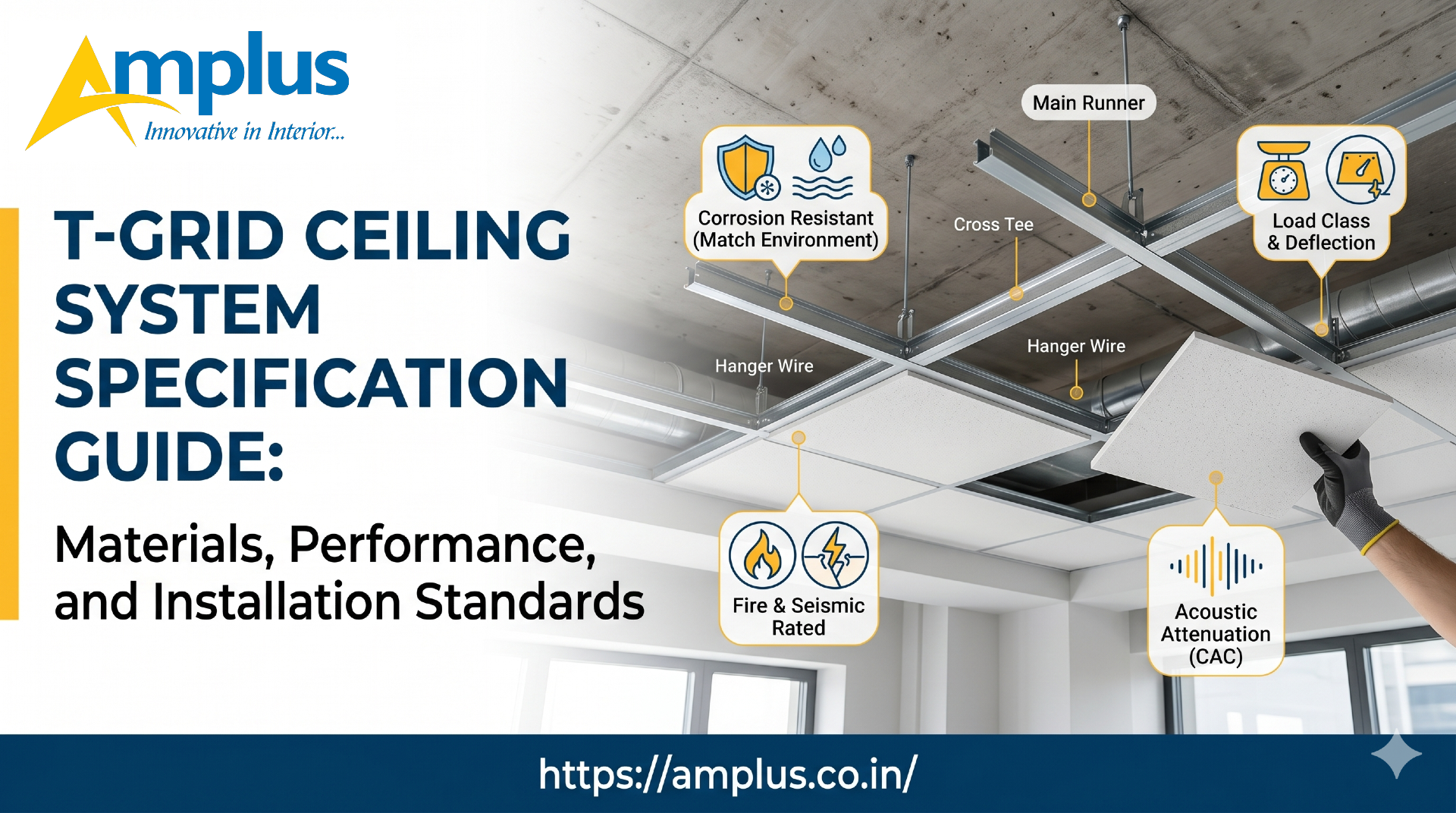
The anatomy is straightforward once you know the parts. Main runners (main tees) are the primary load-carrying members, hung from the slab and typically run at 1200mm centers. Cross tees clip between them to complete the grid, usually creating modules of 600 × 600mm or 600 × 1200mm. A perimeter trim — a wall angle or a stepped shadow-line trim — finishes the edges where the grid meets the walls. And hanger wires or rods suspend the whole assembly from the structure above. Get the grid right, and everything that drops into it has a fighting chance of performing.
Grid Profiles and Materials
Not all grids are equal, and the differences show up both visually and in how long the ceiling lasts.
Profile Widths and Types
The most visible variable is the exposed face width of the tee. A standard grid shows a 24mm face, while slimline systems show a narrower 15mm face for a finer, more contemporary look. Beyond the exposed grid, there are concealed and semi-concealed systems where the framework is hidden behind or within the tile, giving a monolithic appearance at the cost of easy access. Choose based on how much you value a clean look versus simple maintenance — both are legitimate priorities depending on the space.
Materials and Finishes
Most T-grids are hot-dipped galvanized steel, which balances strength, cost, and corrosion resistance well. Aluminium is lighter and naturally corrosion-resistant, stainless steel is reserved for the harshest or most hygienic environments, and grids are finished with a pre-painted or capped face — a steel or Aluminium cap — in the colour you see. The cap finish matters more than people think, because it’s what’s on show for the building’s life.
Corrosion Classes — Match the Grid to the Environment
This is where cheap specification quietly bites. Grids are rated for corrosion resistance by environment, and using a basic indoor-grade grid in a humid, coastal, pool, or kitchen-adjacent space is asking for rust, sag, and staining within a few years. Recognised standards classify grids into corrosion exposure categories, and the rule is simple: specify the corrosion class that matches the actual conditions, not the cheapest grid that fits the modules. In a humid climate, this single decision is often the difference between a ceiling that ages gracefully and one that doesn’t.
Performance: The Specs That Actually Matter
A grid is a structural element, and the right standards let you specify it properly rather than by guesswork.
Load Class and Deflection
T-grid systems are classified by their load-carrying capacity — commonly described as light duty, intermediate duty, and heavy duty under standards such as ASTM C635, which set deflection limits under load. The heavier the tiles and the more integrated light fittings, diffusers, and equipment the grid must carry, the higher the duty class you need. Under-spec the grid and it sags visibly between hangers; the tell-tale wavy ceiling line is almost always an undersized grid or stretched hanger spacing.
Fire Resistance
Where the ceiling forms part of a fire-rated assembly, the grid itself must be a fire-rated grid, often with features like expansion relief and hold-down clips so it behaves predictably as it heats. The tile and grid are tested and certified as a system — you can’t mix a random grid into a fire-rated assembly and assume it still performs. Always specify the grid as part of the rated build-up.
Seismic Performance
In seismic regions, suspended ceilings need specific detailing — adequate perimeter clearances, bracing, and heavier-duty components — covered by seismic installation standards such as ASTM E580. A grid that’s perfectly fine in a stable zone can be a hazard in a seismic one, so this is a code matter, not an option, where it applies.
Acoustics and the Grid’s Role
Here’s an honest point: the grid is not the acoustic component — the tile is. But the grid choice still matters for sound passing between rooms over a partition. Where confidentiality is needed, the system’s CAC (Ceiling Attenuation Class) and the way the partition meets the grid and plenum become important. The grid doesn’t absorb sound, but it’s part of how well the ceiling contains it.
The standards worth knowing across all of this: EN 13964 for suspended ceiling requirements including materials and corrosion classes, and ASTM C635 (manufacture and performance) with ASTM C636 (installation) and ASTM E580 (seismic) on the American side, alongside any local codes that apply.
Installation Standards and Best Practice
A perfectly specified grid can still fail if it’s installed carelessly. The fundamentals:
- Hanger spacing and fixing. Hangers typically run at a maximum of 1200mm along the main runners, with the first hanger close to the perimeter. Critically, hangers must fix to the structure — never to ductwork, pipes, or other services.
- Set out for symmetry. Plan the grid so border tiles at the edges are balanced and reasonably sized. A ceiling with a full tile on one side and a sliver on the other screams amateur, and it’s avoidable with proper setting out.
- Level precisely. Use a laser or water level to establish the perimeter trim and keep the whole plane flat. Lippage and dips between modules are the most visible installation faults.
- Use hold-down clips where needed. Lightweight tiles, fire-rated assemblies, and areas with air pressure or wind uplift need clips so tiles don’t lift or rattle.
- Respect expansion and seismic detailing. Large areas and fire grids need expansion provision; seismic zones need the correct clearances and bracing. Don’t skip these because the ceiling “looks fine” on day one.
- Don’t load the grid with services. Light fittings and diffusers must be independently supported per the system’s requirements, not simply dumped onto the tees.
- Keep access in mind. The whole point of a lay-in grid is access — don’t compromise it with fixings that make tiles impossible to lift.
Conclusion
The tile gets the attention, but the T-grid does the work. It carries the load, contributes to fire and seismic safety, resists (or succumbs to) the environment, and sets the line that makes a ceiling look sharp or sloppy. Specify it as the structural component it is: pick the right profile and finish, match the corrosion class to the conditions, choose a duty class for the real load, respect the fire and seismic standards, and insist on proper setting-out and installation. Do that, and you get a ceiling that’s safe, accessible, good-looking, and built to last. Treat the grid as an afterthought, and it’ll be the first thing to let you down.
Frequently Asked Questions
What is a T-grid ceiling system?
It’s a suspended ceiling framework of metal main runners and cross tees, hung from the structure, that forms a grid of modules into which tiles drop. The lay-in design allows easy access to services above and quick replacement of individual tiles.
What are the standard T-grid module and profile sizes?
Modules are commonly 600 × 600mm or 600 × 1200mm. The grid’s exposed face is typically 24mm wide for standard systems or 15mm for slimline profiles, with concealed and semi-concealed options also available.
What material should a ceiling grid be?
Most grids are hot-dipped galvanized steel for a good balance of strength and corrosion resistance. Aluminium and stainless-steel suit lighter or harsher environments. The key is matching the corrosion class to the actual conditions, especially in humid or coastal areas.
How do I know what load class of grid I need?
Grids are classified by duty — commonly light, intermediate, and heavy duty under standards like ASTM C635. Choose based on the total weight the grid must carry, including tiles and any integrated light fittings and diffusers. Heavier loads need a higher duty class.
Which standards apply to T-grid ceiling systems?
Common references include EN 13964 for suspended ceiling requirements and corrosion classes, and ASTM C635, C636, and E580 for manufacture, installation, and seismic detailing, alongside any local building codes that apply.
Are T-grid ceilings good for soundproofing?
The grid itself doesn’t soundproof — the tile provides absorption, and the system’s CAC affects sound passing between rooms over a partition. For blocking sound between floors, a T-grid is not an isolation solution; that needs mass and decoupling.