Here’s something that catches a lot of people off guard. You spend a small fortune on a premium AV receiver, a set of beautiful speakers, and a subwoofer that can rattle the windows — and the sound is, somehow, a bit of a letdown. The bass is boomy in one seat and missing in the next. Dialogue gets lost. That sweeping cinema moment that gave you goosebumps in the theatre just feels flat in your living room.
The instinct is to blame the gear, or to start shopping for bigger speakers. But nine times out of ten, the equipment is fine. The problem is the room. Every wall, floor, ceiling, and hard surface is bouncing, soaking up, and reshaping the sound before it reaches your ears. Your room is the last and most overlooked component in the audio chain, and it’s quietly undoing the work of everything you bought.
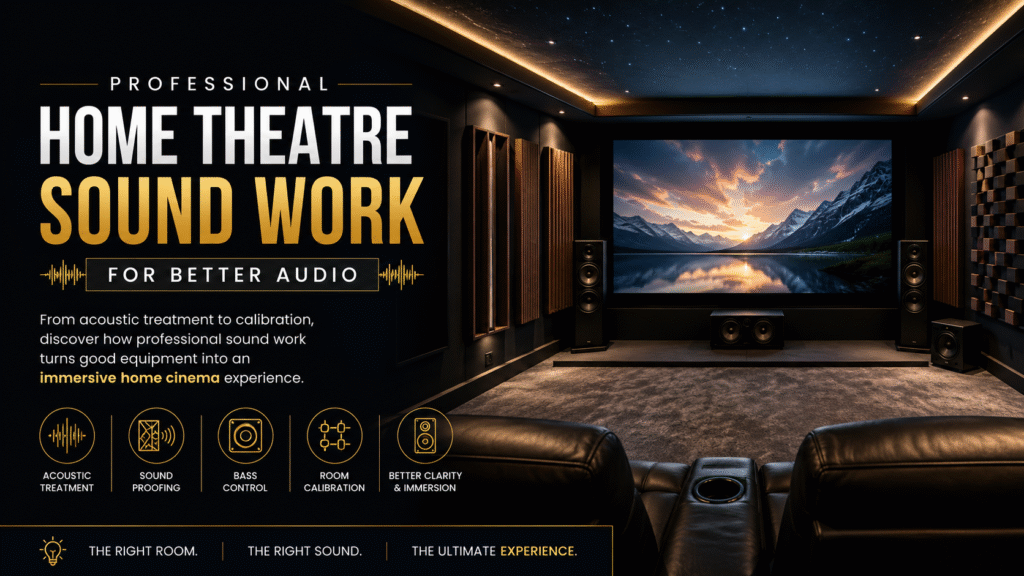
This is exactly what professional home theatre sound work addresses. It’s the difference between playing a film and experiencing one. In this guide we’ll walk through what that work actually involves, why the room matters so much, and how proper acoustic treatment and soundproofing turn good equipment into a genuinely immersive home cinema.
Why Your Room Decides How Your System Sounds
Before treating a room, it helps to understand what’s going wrong inside it. Sound doesn’t travel from your speakers to your ears in a clean straight line. It ricochets off every surface, and those reflections arrive at your ears a fraction of a second after the original sound — muddying clarity and smearing the stereo image.
Reflections and the “Smeared” Image
When sound bounces off side walls, the floor, and the ceiling before reaching you, those early reflections blur the precise placement of sounds. A well-mixed soundtrack should let you point to where a voice or effect is coming from. In an untreated room, everything turns vague.
Reverberation and Echo
Hard, bare surfaces let sound linger long after it should have stopped. This reverberation (often described by a figure called RT60, the time sound takes to decay) makes dialogue harder to follow and the whole room feel washed out. A home theatre wants a controlled, fairly short decay — drier than a normal living room, but not so dead it feels lifeless.
Room Modes and the Bass Problem
Low frequencies are the real troublemakers. In any enclosed room, certain bass notes reinforce each other while others cancel out, depending on the room’s dimensions. The result is room modes — bass that booms in one spot and vanishes in another. This is why your subwoofer can sound overwhelming on the sofa and weak two feet away. Taming bass is the hardest and most important part of the job, and it’s where amateurs almost always fall short.
Flutter Echo
Two parallel hard walls create a rapid, metallic “ping” as sound bounces between them. You can sometimes hear it by clapping in an empty room. It’s distracting and entirely fixable.
What Professional Home Theatre Sound Work Actually Involves
Good acoustic work isn’t about cramming a room with foam. It’s a measured, deliberate process. Here’s what a proper approach looks like.
Acoustic Treatment vs Soundproofing
First, a crucial distinction, because the two get muddled constantly. Soundproofing keeps sound from leaving or entering the room — so your action movie doesn’t wake the kids and street noise doesn’t intrude. Acoustic treatment controls how sound behaves inside the room — clarity, imaging, and bass response. A complete home theatre needs both, and they’re solved with different tools.
Absorption at the Right Places
Broadband acoustic panels placed at the first reflection points — the spots on the side walls and ceiling where sound first bounces toward your seats — clean up imaging dramatically. The trick is precision: a mirror held against the wall while someone watches from the seat shows exactly where these points are. Professional work targets them rather than blanketing every surface.
Ceiling Clouds and Height Channels
The ceiling is a major reflection surface, and with modern object-based formats using height speakers, it matters more than ever. Suspended acoustic clouds above the seating absorb those overhead reflections and sharpen both clarity and the sense of an immersive dome of sound.
Bass Traps
Corners are where low-frequency energy piles up, so that’s where bass traps go. Effective bass control needs real depth and mass — thin panels do almost nothing down low. Getting bass even across all the seats is the single biggest perceived upgrade most rooms experience, and it’s the part that genuinely benefits from experience and measurement.
Diffusion for Liveliness
You don’t want to absorb everything — a totally dead room feels claustrophobic and unnatural. Diffusers, often on the rear wall, scatter sound rather than soaking it up, keeping the room feeling open and spacious while still controlled. Balancing absorption and diffusion is where craft comes in.
Measurement and Room Calibration
This is what truly separates professional work from guesswork. Using measurement software and a calibration microphone, the room’s actual response is mapped — where the peaks, dips, and decay problems are — and treatment is designed around the data, not assumptions. After treatment, the system is calibrated so speaker levels, distances, and crossover settings are dialed in for the seating position. You’re tuning the gear to the treated room, in that order.
Soundproofing the Shell
For the isolation side, the room shell is decoupled and given mass — typically a decoupled ceiling on isolation hangers, dense multi-layer walls, mineral wool in the cavities, a solid acoustic door, and obsessive air-sealing. Bass is the hardest thing to contain, so a home cinema rewards a generous, well-engineered build-up.
Practical Examples Across Different Spaces
The same principles scale across very different environments.
Residential Home Theatres
The classic case: a dedicated room or basement where a homeowner wants real cinema sound without disturbing the house. Here, the full package — first-reflection absorption, ceiling clouds, corner bass traps, rear diffusion, a decoupled and sealed shell, then calibration — delivers the biggest, most satisfying transformation.
Commercial Cinemas and Screening Rooms
Commercial spaces work to tighter standards and larger volumes, but the logic is identical: control reflections, manage bass, isolate from neighboring spaces, and calibrate to reference levels so every showing sounds as the mix intended.
Offices and Media Rooms
Corporate media rooms, boardrooms with AV, and presentation spaces need speech intelligibility above all. Acoustic treatment that controls reverberation makes presentations clear and video calls intelligible, while light soundproofing keeps confidential discussions private.
Educational Institutions
AV labs, media studios, and lecture halls live or die on clarity. Treating reverberation so speech stays crisp at the back of a hall, and isolating media rooms so recording and playback are clean, directly improves the learning experience.
Auditoriums
Auditoriums are large-scale acoustic design problems where reflection, absorption, and isolation are balanced across a big volume for an audience rather than a single seat. The ceiling and walls become a designed acoustic system, engineered from the outset.
Home Theatre Enthusiasts
For the dedicated hobbyist chasing reference-grade sound, professional treatment is what unlocks the gear they’ve already invested in. It’s the upgrade that makes a high-end system finally perform the way the spec sheet promised.
Expert Tips from the Field
A few things we tell almost every client before we start:
- Treat the room before you upgrade the gear. A mid-range system in a properly treated room beats a high-end system in a bare one, almost every time. This is the most cost-effective advice in audio.
- Bass is where the money goes. Resist the temptation to spend everything on visible wall panels. Corner bass traps with real depth do the heavy lifting that you actually feel.
- Don’t over-deaden the room. Killing every reflection makes a space feel oppressive and tiring. The goal is control with life, not silence.
- Symmetry matters. Keep the left and right sides of the room acoustically matched so the stereo and surround image stays centred and accurate.
- Soundproofing and treatment are different jobs. Foam on the walls won’t stop sound escaping, and mass in the walls won’t fix your room’s echo. Plan for both.
- Measure, don’t guess. A calibration microphone and software reveal problems your ears can’t pinpoint. Decisions made on data outperform decisions made on hunches.
- Integrate aesthetics from the start. Good acoustic treatment can be fabric-wrapped, hidden, or designed to look intentional. A great-sounding room shouldn’t have to look like a science project.
Frequently Asked Questions
Will acoustic treatment really make my home theatre sound better?
Yes, often dramatically. The room shapes everything your speakers produce. Targeted absorption, bass traps, and calibration clean up imaging, tighten bass, and improve dialogue clarity — usually a bigger upgrade than buying new equipment.
What’s the difference between soundproofing and acoustic treatment?
Soundproofing stops sound leaving or entering the room. Acoustic treatment controls how sound behaves inside it — clarity, imaging, and bass. A complete home theatre needs both, but they use different materials and techniques.
Is bass really the hardest part to fix?
Yes. Low frequencies create room modes that make bass uneven from seat to seat, and controlling them requires deep, well-placed bass traps. It’s the most technically demanding part of the work and where professional measurement pays off most.
Can I just use acoustic foam to treat my room?
Foam absorbs higher frequencies and can reduce some echo, but it does very little for bass and nothing for soundproofing. A balanced design uses broadband panels, bass traps, and diffusion — not foam alone.
Do I need to measure the room, or can it be done by ear?
Experienced ears help, but measurement is what makes results repeatable and precise. A calibration mic and software map the room’s real problems so treatment is designed around data rather than guesswork.
Will too much treatment make my room sound dead?
It can. Over-absorbing leaves a room feeling lifeless and unnatural. Good design balances absorption with diffusion so the room stays controlled but still feels open and alive.
Does the ceiling matter for home theatre sound?
Very much. The ceiling is a major reflection surface, and with height-channel formats it’s part of the immersive effect. Ceiling clouds and treatment improve clarity and the sense of enveloping sound.
Conclusion
The most expensive speakers in the world can only sound as good as the room lets them. That’s the heart of professional home theatre sound work: treating the room as the final, decisive component in the audio chain. By controlling reflections, taming bass with proper traps, balancing absorption and diffusion, isolating the space, and calibrating the system to the treated room, you transform raw equipment into genuine cinematic immersion.
Do it well and the difference isn’t subtle. Dialogue snaps into focus, bass becomes tight and even across every seat, and the soundtrack finally surrounds you the way the mix intended. The gear stops fighting the room — and starts performing.