If you’ve ever stood under a ceiling that’s started to bow in the middle, or noticed brown water stains spreading across a freshly painted office soffit, you already understand why ceiling material matters more than most people give it credit for. It’s the one surface in a room nobody looks at until something goes wrong. And when it does go wrong, it usually goes wrong in an expensive, visible, and slightly embarrassing way.
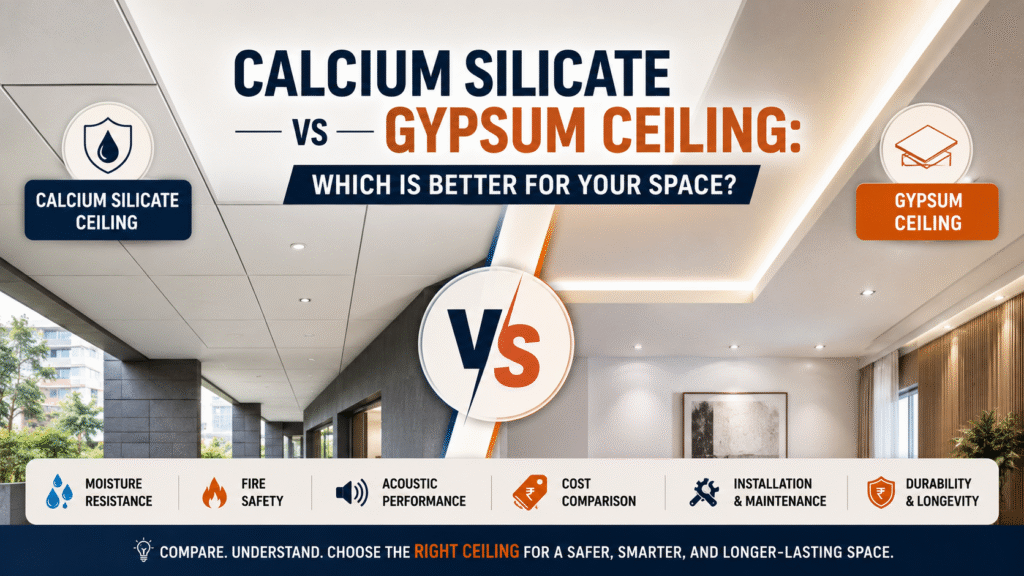
We get this question almost every week from homeowners, architects, and facility managers alike: calcium silicate ceiling vs gypsum ceiling — which one should I actually pick? It sounds like a simple either/or, but the honest answer is that one isn’t universally “better” than the other. They’re built differently, they fail differently, and they shine in completely different situations.
This guide walks through how each material behaves in the real world — not just on a spec sheet. We’ll cover moisture, fire, acoustics, cost, installation, and the kind of practical trade-offs that only show up after a few hundred ceilings have been installed. By the end, you’ll know exactly which board belongs in your bedroom, your boardroom, or your home theatre.
What Exactly are These Two Materials?
Before comparing them, it helps to understand what you’re actually buying, because the names get thrown around loosely on site.
Gypsum Board (Plasterboard)
A gypsum ceiling board has a core of gypsum — calcium sulphate — sandwiched between two layers of paper or fibre lining. It’s the workhorse of the false ceiling world. Lightweight, easy to cut with a utility knife, and quick to finish into a seamless, paint-ready surface, gypsum is what most people picture when they think of a modern interior ceiling.
There’s a useful quirk in its chemistry too: gypsum holds chemically bound water inside its crystals. When exposed to fire, that water is slowly released as steam, which is why gypsum genuinely slows the spread of flame rather than just resisting it on paper.
Calcium Silicate Board
A calcium silicate board is made from lime, silica, and reinforcing fibres (usually cellulose), cured under high pressure and temperature. The result is a denser, harder, far more stable board. It doesn’t rely on a paper face, which is the single biggest reason it behaves so well in tough environments.
Where gypsum is the comfortable all-rounder, calcium silicate is the specialist you call in when conditions get harsh — heat, humidity, or both.
The Head-to-Head Comparison between Calcium Silicate Ceiling vs Gypsum Ceiling
Let’s get into the points that actually decide a project.
Moisture and Humidity Resistance
This is where the two-part ways most dramatically. Standard gypsum boards do not enjoy water. Leave one near a leaking AC tray or a monsoon-season seepage spot and it’ll sag, soften, and eventually crumble. Moisture-resistant (“green”) gypsum variants exist and they help, but they buy you time rather than immunity.
Calcium silicate, on the other hand, simply doesn’t care about humidity the way gypsum does. It won’t rot, swell, or feed mould. In a coastal city like Surat, or anywhere with serious monsoon humidity, this difference is not academic — it’s the line between a ceiling that lasts fifteen years and one you’re patching after two.
Verdict: Calcium silicate wins clearly for wet or humid areas. Gypsum is fine for dry, climate-controlled interiors.
Fire Resistance
Both materials are respectable performers here, which surprises people who assume only one is “fire-rated.”
Gypsum’s steam-release behavior gives fire-rated (Type X) variants a strong fire rating, often one to two hours depending on the build-up and number of layers. Calcium silicate is fully non-combustible by nature and tends to hold its structural integrity at higher temperatures for longer, which is why it’s a favorite for fire-rated partitions, service shafts, and exterior soffits.
For most homes and offices, a properly specified gypsum system meets fire-safety requirements comfortably. For high-risk or code-critical zones — kitchens, plant rooms, escape corridors — calcium silicate gives you extra headroom. Always confirm the actual tested rating on the manufacturer’s datasheet rather than trusting general assumptions, and check it against the fire norms applicable to your building category.
Verdict: Both are good. Calcium silicate edges ahead for demanding fire-rated applications.
Acoustic Performance
Here’s a myth worth busting: neither board is “acoustic” on its own. A bare gypsum or calcium silicate sheet is a fairly hard, reflective surface. Real acoustic performance — whether you want to absorb echo or block sound from travelling — comes from the system, not the board alone.
Sound absorption (measured as NRC, the Noise Reduction Coefficient) is achieved through perforated boards backed with mineral wool or glass wool and an air gap. Both gypsum and calcium silicate are available in perforated acoustic versions for exactly this.
Sound blocking, or transmission loss (measured as STC, Sound Transmission Class), depends heavily on mass and on breaking the vibration path. Denser boards, multiple layers, resilient channels, and insulated cavities all matter far more than which of the two materials you start with.
In practice, for a home theatre or a recording-grade room, we rarely treat the ceiling board choice as the acoustic decision — the build-up around it is what does the heavy lifting. Calcium silicate’s higher density can be a small advantage for transmission loss, but a well-engineered gypsum system can match or beat a poorly designed calcium silicate one.
Verdict: A tie on the raw board. The acoustic system design decides the outcome.
Finish and Aesthetics
If you want a flawless, monolithic, plastered look with crisp shadow gaps and curves, gypsum is hard to beat. Its paper face takes joint compound and paint beautifully, and skilled installers can make joints disappear entirely.
Calcium silicate gives a clean finish too, but its joints generally need more care, and the board’s hardness makes intricate curved or layered ceiling designs more laborious.
Verdict: Gypsum for designer, detail-heavy interiors. Calcium silicate when durability outranks decorative complexity.
Installation and Handling
Gypsum is genuinely pleasant to work with — light, scoreable with a knife, fast to install. That speed translates directly into lower labor costs and quicker project timelines.
Calcium silicate is heavier and harder. It usually needs power tools to cut, the dust contains silica (so proper masks and dust control are non-negotiable), and the framework often has to be beefed up to carry the extra weight. None of this is a dealbreaker — it just needs a crew that knows the material.
Verdict: Gypsum is faster and easier. Calcium silicate demands more skill, time, and care.
Cost
There’s no avoiding it: calcium silicate board costs more, both in material and in the labour to install it. Gypsum is the budget-friendly option and the default for large areas where conditions are kind.
But it’s worth thinking in lifecycle terms, not just upfront price. If you install cheaper gypsum in a humid bathroom and replace it twice in five years, the “savings” evaporate. Match the material to the environment and the cheaper option might actually be the dearer one over time.
Verdict: Gypsum wins on initial cost. Calcium silicate can win on total cost of ownership in tough conditions.
Real-World Applications: Where Each One Belongs
Theory is fine, but here’s how we actually spec these on live projects.
Residential Homes
For living rooms, bedrooms, and dry indoor spaces, gypsum is almost always the right call — affordable, beautiful, and easy to detail. The exception is wet zones: bathrooms, open balconies, kitchen ceilings exposed to steam, and homes in heavy-humidity coastal belts. There, calcium silicate (or at minimum a moisture-resistant board) earns its premium.
Commercial Offices
Open-plan offices love gypsum for its clean look and acoustic flexibility — perforated gypsum tiles with insulation tame the open-office echo nicely. Calcium silicate comes into play for service corridors, server rooms, pantries, and any soffit near plumbing or HVAC where a leak is a question of when, not if.
Educational Institutions
Schools and colleges are high-traffic, long-life buildings where maintenance budgets are tight. Calcium silicate’s durability and fire performance make it a sensible choice for corridors and labs, while gypsum acoustic ceilings work well inside classrooms and libraries where keeping noise down aids concentration.
Auditoriums
Auditoriums are pure acoustics-and-fire territory. The ceiling is part of a designed sound environment, so the choice leans on engineered absorption and the building’s fire requirements rather than the board brand. Both materials feature here, almost always in perforated, insulation-backed systems.
Home Theatres
This is the one our enthusiast readers care about most. A home theatre ceiling has two jobs: stop sound leaking out to the rest of the house (transmission loss) and control reflections inside the room (absorption). That means mass, decoupling, and absorption layers — not just a single board. Gypsum is common because it’s easy to double up and seal, but the real magic is in the cavity insulation, the resilient mounts, and the air-tight detailing.
Expert Tips from Amplus India
A few things we’ve learned the hard way that no spec sheet will tell you:
- Match the board to the room, not the budget. The most expensive ceiling repair is the one you do twice. Spending a little more on calcium silicate in a wet zone almost always pays off.
- Mass and decoupling beat board choice for soundproofing. If acoustics are the goal, invest in the system — insulation, resilient channels, sealed joints — before debating which board to buy.
- Always check the actual tested rating. “Fire-rated” and “acoustic” are marketing words until you see the NRC, STC, or fire-resistance number on a real datasheet from a credited test.
- Don’t skimp on the framework. Calcium silicate is heavier than gypsum. Use the right grid and hanger spacing or you’ll get sag regardless of how good the board is.
- Mind the dust. Cutting calcium silicate releases fine silica. Insist your installer uses masks and dust extraction — it’s a genuine health point, not a formality.
- Mix and match where it makes sense. There’s no rule that says one building must use one material. Use gypsum for the dry, decorative areas and calcium silicate for the wet, hot, or fire-critical zones.
Frequently Asked Questions
Is calcium silicate ceiling better than gypsum?
Not universally. Calcium silicate is better for moisture, fire, and durability, while gypsum is better for cost, finish quality, and ease of installation. The right choice depends entirely on the room and conditions.
Which ceiling is better for bathrooms and kitchens?
Calcium silicate, or at minimum a moisture-resistant gypsum board. Standard gypsum will eventually sag and degrade in steam and humidity.
Are calcium silicate or gypsum ceilings better for soundproofing?
The board alone isn’t the deciding factor. Acoustic performance comes from the full system — perforation, insulation, air gaps, and decoupling. Calcium silicate’s density gives a slight edge for sound blocking, but a well-designed gypsum system can match it.
Which is more expensive?
Calcium silicate costs more upfront in both material and labor. Gypsum is the more economical option, though calcium silicate can be cheaper over the building’s lifetime in harsh conditions because it lasts longer.
Can I use gypsum in my home theatre?
Yes, gypsum is very common in-home theatres, usually doubled up and sealed. Just remember the soundproofing comes from the overall build-up (mass, decoupling, insulation), not the board by itself.
Which ceiling looks better?
Gypsum generally gives a smoother, more seamless, designer-friendly finish and handles curves and shadow gaps better. Calcium silicate finishes cleanly but suits simpler, durability-led designs.
Do both materials resist fire?
Yes. Gypsum slows fire by releasing bound water as steam, and fire-rated variants perform strongly. Calcium silicate is non-combustible and holds up at higher temperatures, making it ideal for fire-critical zones.
Conclusion
So, calcium silicate ceiling vs gypsum ceiling — which is better? The most useful answer is the least exciting one: it depends on where the ceiling is going. Choose gypsum when you want a beautiful, cost-effective finish in dry, comfortable interiors. Choose calcium silicate when moisture, heat, or fire safety raise the stakes and you need a ceiling that simply won’t quit.
For most projects, the smartest approach isn’t picking a side at all — it’s using each material where it’s strongest. And when acoustics enter the picture, remember that the real performance lives in the system around the board, not the board itself.