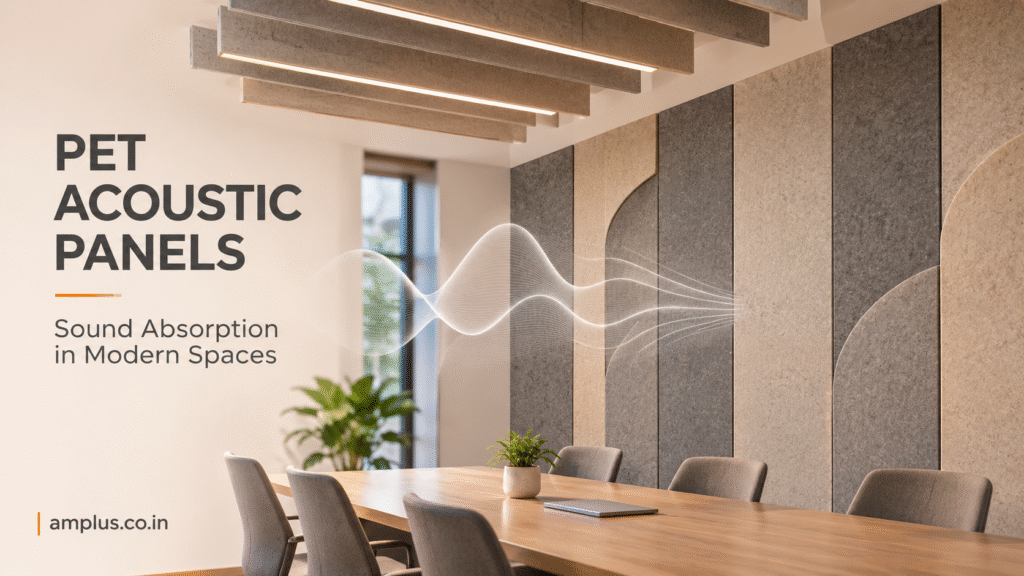
Modern interior design increasingly emphasizes open layouts, hard surfaces like glass and concrete, and minimalist aesthetics. While visually striking, these environments often suffer from excessive noise reflection and reverberation. In corporate offices, educational institutions, and commercial venues, managing indoor acoustics is essential for comfort and concentration. Among modern acoustic treatment solutions, PET panels have emerged as a versatile choice. Understanding how these panels absorb sound helps architects, designers, and facility managers optimize interior soundscapes effectively.
Understanding the Sound Absorption Properties of PET Panels
PET acoustic panels are manufactured primarily from polyethylene terephthalate (PET) fibres, with many products incorporating recycled content depending on the specific manufacturer and product grade. Structurally, these panels feature a porous, fibrous matrix that allows incident sound waves to enter the material rather than reflecting off it.
When airborne sound waves strike a PET acoustic panel, the acoustic energy penetrates the porous network. Within the intricate web of fibres, sound energy is dissipated through energy conversion mechanisms, including friction between vibrating air molecules and the fibre surfaces, as well as viscous and thermal losses. This energy transformation significantly reduces reflected sound energy, helping to control reverberation and echo within a room.
It is important to distinguish sound absorption from sound insulation. Sound absorption reduces reflected sound energy within a single space, whereas sound insulation or soundproofing blocks sound transmission between separate rooms. PET acoustic panels provide acoustic treatment to refine internal room acoustics rather than acting as full soundproofing barriers.
Acoustic performance is typically quantified using standardized measurement methods, such as the Noise Reduction Coefficient. NRC provides a single-number rating indicating the average sound absorption performance across specific frequencies. However, NRC does not capture detailed frequency-dependent behaviour across low, mid, and high frequencies, meaning comprehensive test reports should always be reviewed alongside NRC ratings.
Factors That Influence PET Panel Acoustic Performance
The actual acoustic effectiveness of PET panels in a real-world environment depends on several material, installation, and spatial variables.
Panel Thickness and Density
Panel thickness directly influences acoustic absorption, particularly at lower frequencies. Thicker panels generally provide greater low-frequency absorption because longer wavelength sound waves require a deeper porous medium to dissipate effectively. Material density and fibre compaction also influence acoustic behaviour; however, density alone does not dictate performance. A denser panel is not automatically superior across all frequencies. Reviewing independent laboratory test reports helps verify how specific thicknesses and densities perform under standardized testing conditions.
Surface Coverage and Placement
The total amount of treated surface area relative to the room’s total boundary surfaces affects overall room acoustics. Strategic placement is critical for targeting primary reflection points on walls and ceilings. Room geometry, existing hard finishes, furniture, and room occupancy all interact with installed panels. Effective acoustic design involves targeted placement based on specific acoustic challenges rather than arbitrarily covering every surface.
Air Gaps and Installation Methods
Introducing an air gap between the PET panel and the backing wall can significantly improve low-frequency acoustic absorption. Mounting panels directly against a rigid wall behaves differently compared to installing them with an air cavity or suspending them from the ceiling as baffles or clouds. Following tested installation configurations ensures that the installed system performs in alignment with laboratory ratings.
Where PET Acoustic Panels Work Best?
Selecting the right location for PET acoustic panels depends on room function, noise sources, and operational objectives.
Corporate Offices and Meeting Rooms
Open-plan workspaces, meeting rooms, and collaboration zones frequently experience high ambient noise and speech buildup. Strategic placement of wall and ceiling panels helps control reverberation, improving speech clarity and focus without guaranteeing absolute speech privacy or productivity boosts.
Educational Institutions
Classrooms, lecture halls, and libraries require high speech intelligibility. Controlling excessive reverberation in occupied rooms supports better learning environments, taking into account room volume, student occupancy, and teaching activities.
Commercial and Hospitality Interiors
Restaurants, hotels, reception areas, and retail spaces benefit from balanced sound environments. Acoustic treatment improves customer comfort while preserving modern interior aesthetics and design flexibility.
How PET Acoustic Panels Improve Indoor Acoustic Comfort?
Appropriate acoustic treatment yields tangible improvements in interior environments. By reducing excessive reverberation and controlling sound reflections, PET panels enhance speech clarity in appropriate settings and foster greater acoustic comfort in shared spaces. Furthermore, their modern aesthetic versatility allows designers to combine functional acoustic control with visual elegance.
Choosing PET Acoustic Panels for Different Interior Requirements
Selecting suitable PET acoustic panels requires evaluating room size, intended function, existing acoustic issues, frequency absorption needs, thickness, mounting methods, aesthetic finishes, fire performance ratings, and environmental certifications. Reviewing technical data sheets and acoustic test reports ensures informed decision-making.
For expert guidance and tailored interior solutions, explore the offerings available at the Amplus. Visit our Contact Page or discover our range of ceiling and acoustic solutions on our Products Page.