
Most people treating a noisy commercial space look straight up. The acoustic ceiling is the obvious first move — and often the right one. But there’s a reason a treated ceiling sometimes still leaves a room feeling harsh: the walls are quietly reflecting sound straight back at head height, right where conversations happen.
That’s where acoustic wall tiles come in. They put absorption exactly where sound is generated and where people are, and in the right space they turn a ceiling-only fix into a genuinely comfortable room. But like every acoustic product, they’re easy to specify badly. This guide covers how to choose and specify acoustic wall tiles for commercial interiors so they actually perform — and look intentional doing it.
Why Treat the Walls, Not Just the Ceiling?
A ceiling handles a lot of a room’s reverberation, but sound bouncing horizontally between parallel hard walls creates its own problems — flutter echo, poor speech clarity, and a general harshness. In tall spaces the ceiling is also simply too far from ear level to do everything.
Acoustic wall tiles add absorption at the height where it counts. They’re especially valuable where the ceiling can’t be treated fully — exposed-structure interiors, glazed atria, or heritage spaces — and where sound needs controlling close to the people creating it. Treating both surfaces, ceiling and walls, is how you get a room that genuinely sounds calm rather than just quieter.
Choosing the Right Acoustic Wall Tile
Materials
Common options include PET felt (recycled polyester — lightweight, colorful, cuttable, and increasingly the default for its sustainability and finish), fabric-wrapped mineral or glass wool panels (high absorption, a more classic look), foam-cored fabric tiles, and perforated timber or slat systems backed with absorptive material for a warm, premium feel. Each balances acoustic performance, appearance, durability, and cost differently.
Acoustic Performance
Specify by tested NRC or αw — how much sound the tile absorbs — measured to standards such as ISO 354 or ASTM C423. Thicker panels and those with an air gap behind them absorb more, particularly at lower frequencies. As with any acoustic product, insist on tested figures for the actual build-up rather than trusting appearance.
Durability and Impact Resistance
This matters more on walls than ceilings, because walls get touched, knocked, and leaned on. In circulation areas, schools, and busy public spaces, choose impact-resistant or hard-wearing finishes. A soft fabric panel that looks lovely in a showroom will look tired fast in a school corridor.
Fire Performance
Wall tiles must meet the fire requirements for the building and location. Confirm the tested fire rating on the datasheet — this is not an area to assume or value-engineer, especially in public and commercial buildings.
Aesthetics
Wall tiles are far more visible than ceiling tiles, at eye level and up close. Colour, texture, shape, and pattern are part of the interior design, not an afterthought — which is a big reason PET felt and fabric systems, available in many colors and custom shapes, have become so popular.
Placement: Where Tiles Actually Work
Product choice is only half the job; placement decides results. Target the reflection points and the large hard surfaces bouncing sound around — the walls facing each other across a room, the wall behind a presenter or a busy work area. You don’t need to cover every wall; well-placed absorption on the right surfaces often does more than blanket coverage in the wrong places. And calculate roughly how much absorption the space needs, because a few decorative tiles won’t fix a genuinely reverberant room.
Practical Applications
- Offices: wall tiles tame meeting rooms, focus booths, and open areas where ceiling treatment alone leaves speech unclear; they double as branding through colour and pattern.
- Educational institutions: impact-resistant wall panels improve speech clarity in classrooms and cut noise in corridors and halls.
- Auditoriums: wall treatment is part of an engineered balance of absorption and reflection, placed precisely.
- Retail and hospitality: tiles cut restaurant and showroom din while carrying the brand look.
- Home theatres: wall panels at first reflection points sharpen imaging and dialogue clarity, working alongside the soundproofed shell a cinema needs.
- Residential homes: in open-plan living spaces and home offices, wall tiles add absorption and a design feature where a treated ceiling isn’t enough.
For commercial projects that require a combination of acoustic performance and interior design, solutions from Amplus India can be considered alongside other acoustic treatment options.
Conclusion
Acoustic wall tiles are the missing half of many acoustic projects — absorption placed at ear level, at the reflection points a ceiling can’t reach. Choose them by tested NRC rather than appearance, match the material and durability to the space, confirm the fire rating, and place them where sound actually reflects. Do that and you get a room that looks considered and genuinely sounds calm. Treat them as decoration alone and you’ll get the look without the quiet.
Frequently Asked Questions
Do acoustic wall tiles really work?
Yes, when chosen and placed well. They add sound absorption at ear level and at reflection points, reducing echo, flutter, and harshness that a ceiling alone may leave. Performance depends on the tile’s tested NRC, its thickness, and correct placement.
Where should acoustic wall tiles be placed?
At reflection points and on the large hard surfaces bouncing sound around — typically walls facing each other across a room, and the wall behind a presenter or busy area. Targeted placement usually outperforms spreading tiles evenly across every wall.
What’s the difference between acoustic wall tiles and soundproofing?
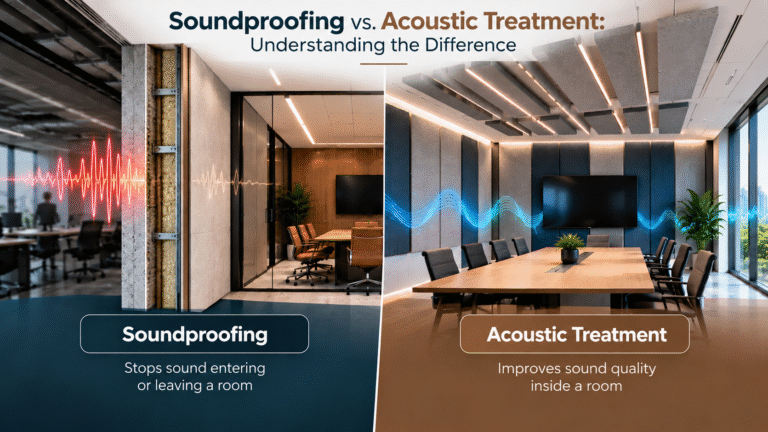
Acoustic wall tiles absorb sound within a room to reduce echo and reverberation. Soundproofing blocks sound passing through the wall to another space, which requires mass and decoupling. They solve different problems and shouldn’t be confused.
Which material is best for acoustic wall tiles?
It depends on priorities. PET felt is lightweight, sustainable, and colorful; fabric-wrapped mineral wool offers high absorption; perforated timber gives a premium look. Match the material to the required NRC, durability, fire rating, and design intent.
Are acoustic wall tiles durable enough for busy areas?
Some are, some aren’t. Soft fabric panels suit calmer spaces, while circulation areas, schools, and public buildings need impact-resistant finishes. Always match the tile’s durability to the traffic the wall will actually see.