Perforated acoustic panels are everywhere in good commercial design — the neat rows of holes in a metal ceiling, the timber slats in a boardroom, the crisp panels lining a lecture hall. They look clean and deliberate, and they can be genuinely excellent sound absorbers.
But here’s the catch we see caught out again and again: the holes you can see are not the part that absorbs sound. Specify a perforated panel by its looks alone and you can end up with a handsome ceiling that does almost nothing acoustically. This short guide covers what actually drives performance, so you specify with confidence.
How Perforated Acoustic Panels Work?
A perforated panel is, on its own, a fairly hard, reflective surface with holes punched through it. The absorption doesn’t happen at the panel — it happens behind it. This is particularly important when specifying perforated metal ceiling systems for large commercial buildings, where the panel, acoustic backing, and cavity need to work together to control noise.
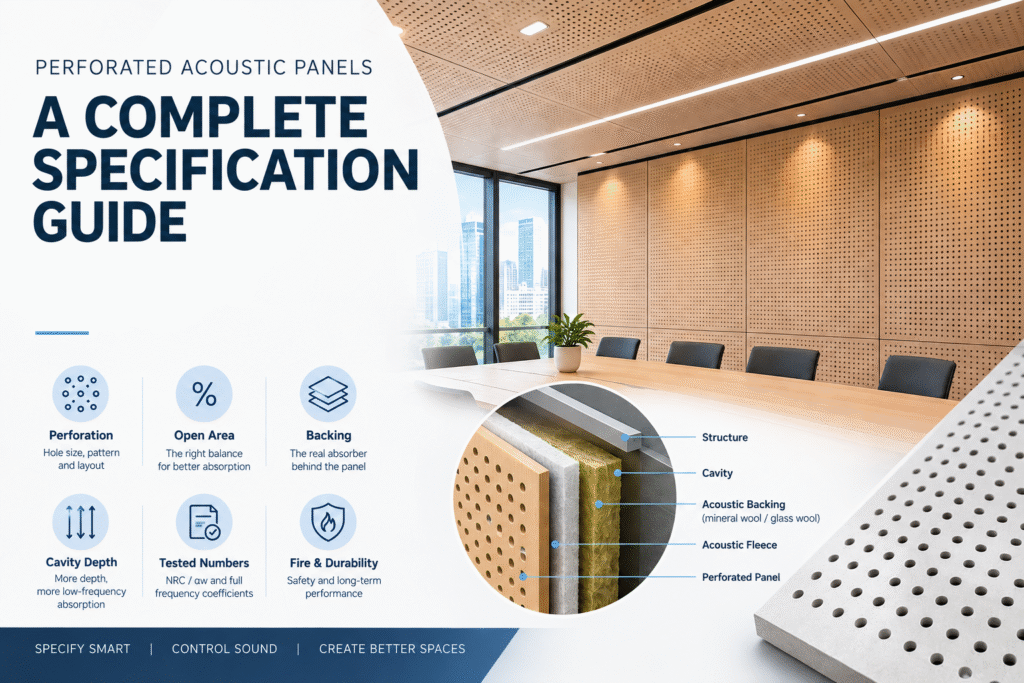
Sound passes through the perforations into an absorptive layer mounted behind the panel — typically an acoustic fleece or tissue plus a pad of mineral wool or glass wool — and then into the air cavity beyond. The soft backing traps and dissipates the sound energy. The perforated face is essentially a durable, decorative, acoustically transparent skin over the real absorber.
That single fact governs the entire specification: the panel face is cosmetic and structural; the backing and cavity do the acoustic work.
The Variables That Decide Performance
Open Area Percentage
The most important number after the acoustic rating itself. Open area is the proportion of the panel surface made up of holes — how much sound can actually pass through to the backing. Too low an open area and the panel behave more like a solid reflective surface, no matter how good the backing is. Broadly, a higher open area lets more sound reach the absorber and supports broader absorption, though it’s the combination of variables that sets the result.
Perforation Pattern and Hole Size
Hole diameter, spacing, and pattern affect both acoustics and appearance. Fine micro-perforations can be nearly invisible from a normal viewing distance while still passing sound; bold decorative patterns make a visual feature of the perforation. Both can perform well — the point is that the pattern is an acoustic variable, not just a design one.
The Acoustic Backing
This is where the absorption lives. The type, thickness, and density of the mineral or glass wool behind the panel, and the acoustic fleece controlling airflow through the holes, largely determine how much sound is absorbed. Change the backing and you change the performance, even behind an identical-looking face. Value-engineer the backing out and the acoustics disappear with it — the most common way these panels fail.
Cavity Depth
The air gap between the panel and the structure behind it matters more than most people expect, especially for lower frequencies. A deeper cavity improves absorption of bass and lower-mid sound — often the hardest part of the spectrum to control. Perforation, backing, and cavity depth are tuned together to target a frequency range.
Specify by the Tested Numbers
Never specify a perforated acoustic panel on appearance or open area alone. Insist on the tested sound absorption data — NRC or αw with the full frequency coefficients behind it — measured to recognised standards such as ISO 354 or ASTM C423. Critically, the figures must apply to the complete system as installed: the exact panel, perforation, backing, and cavity depth you’re specifying. A test result for a different backing or mounting tells you very little about what you’ll actually get.
Practical Applications
- Offices: perforated metal or timber ceilings control open-plan noise while giving a clean, modern finish.
- Educational institutions: perforated panels keep reverberation low for speech clarity in classrooms, halls, and atria.
- Auditoriums: perforated systems form part of an engineered scheme, placed where absorption is wanted and balanced against reflective surfaces.
- Retail and hospitality: they cut din while carrying a design-led look.
- Home theatres: perforated panels with proper backing handle in-room reflections, working alongside — not instead of — the soundproofed, decoupled shell a cinema needs.
- Residential homes: perforated timber slat ceilings bring warmth and echo control to open-plan living spaces, provided the backing is specified rather than assumed.
For commercial projects requiring integrated interior acoustic solutions, Amplus India offers expertise in acoustic ceiling and sound management systems for different commercial environments.
Conclusion
Perforated acoustic panels are a versatile, good-looking way to control sound — but only when specified as a system rather than a surface. The holes let sound through; the backing and cavity absorb it; and the tested numbers, for the exact build-up you install, tell you what you’ll really get. Get those right and you have a ceiling that looks sharp and performs. Chase the look alone and you may buy a beautiful panel that leaves the room as noisy as before.
Frequently Asked Questions
Do perforated acoustic panels actually absorb sound?
Only as a complete system. Sound passes through the perforations into an absorptive backing of fleece and mineral or glass wool behind the panel. Without that backing, the perforated face largely reflects sound.
What is open area percentage?
It’s the proportion of the panel surface made up of perforations. It governs how much sound reaches the absorptive backing, so along with hole size, backing, and cavity depth it strongly influences absorption. Too low an open area makes a panel behave like a solid surface.
Which matters more, the panel or the backing?
The backing. The perforated face is essentially a decorative, acoustically transparent skin, while the mineral or glass wool behind it does the actual absorbing. Two identical-looking panels can perform very differently depending on their backing.
How should I compare perforated panels?
By tested NRC or αw values with the full frequency data, measured to ISO 354 or ASTM C423, for the complete system including the backing and cavity depth you intend to install — not by the panel’s appearance or open area alone.
Do perforated panels soundproof a room?
No. They absorb sound within a space to reduce echo and reverberation. Blocking sound between rooms or floors requires mass and decoupling, which is a separate soundproofing system.