You’ve almost certainly stood in one of these spaces and felt the problem without naming it. A vast airport concourse where the announcement you actually need is swallowed by a wall of echo. A hotel atrium where every footstep and conversation seems to hang in the air. A shopping mall that sounds like a swimming pool. These are big, beautiful buildings — and acoustically, many of them are a nightmare.
The reason is simple physics. Large commercial buildings tend to be full of hard, reflective surfaces — glass, concrete, polished stone, exposed structure — wrapped around enormous volumes of air. Sound has nothing to grab onto, so it bounces and lingers, building into a wash of noise that makes speech hard to follow and the whole space feel stressful. Fix that, and the building doesn’t just sound better; it works better.
This is where perforated metal ceiling systems earn their place. They’re one of the most reliable tools for taming noise across large, high-traffic interiors — durable enough for the conditions, handsome enough for flagship architecture, and, when specified correctly, genuinely effective at absorbing sound. The catch is in that phrase, “when specified correctly.” This guide explains how these systems actually work, where they shine, and the mistakes that quietly waste a lot of money.
The Noise Problem in Large Commercial Buildings
Before the solution, it helps to understand exactly what you’re fighting in a big building.
The main enemy is reverberation — sound continuing to bounce around long after its source has stopped. In a large volume with hard surfaces, that decay time stretches out, and the result is a noisy, fatiguing space where speech intelligibility collapses. In an airport or station, that’s not just unpleasant; it’s a safety and operations issue when people can’t understand announcements.
On top of reverberation, you’ve got constant footfall and crowd noise, the hum and rush of large HVAC systems, and the sheer scale of the space, which means you need a lot of sound-absorbing area to make a difference. The ceiling is usually the largest available surface to put that absorption on — which is exactly why it carries so much of the acoustic load in these buildings.
How Perforated Metal Ceilings Actually Absorb Sound?
Here’s the part that surprises people: a metal ceiling, on its own, is a hard reflective surface — the opposite of what you want. So how does it absorb sound? The answer is that the metal panel is only half the system.
The Panel Is Only Half the System
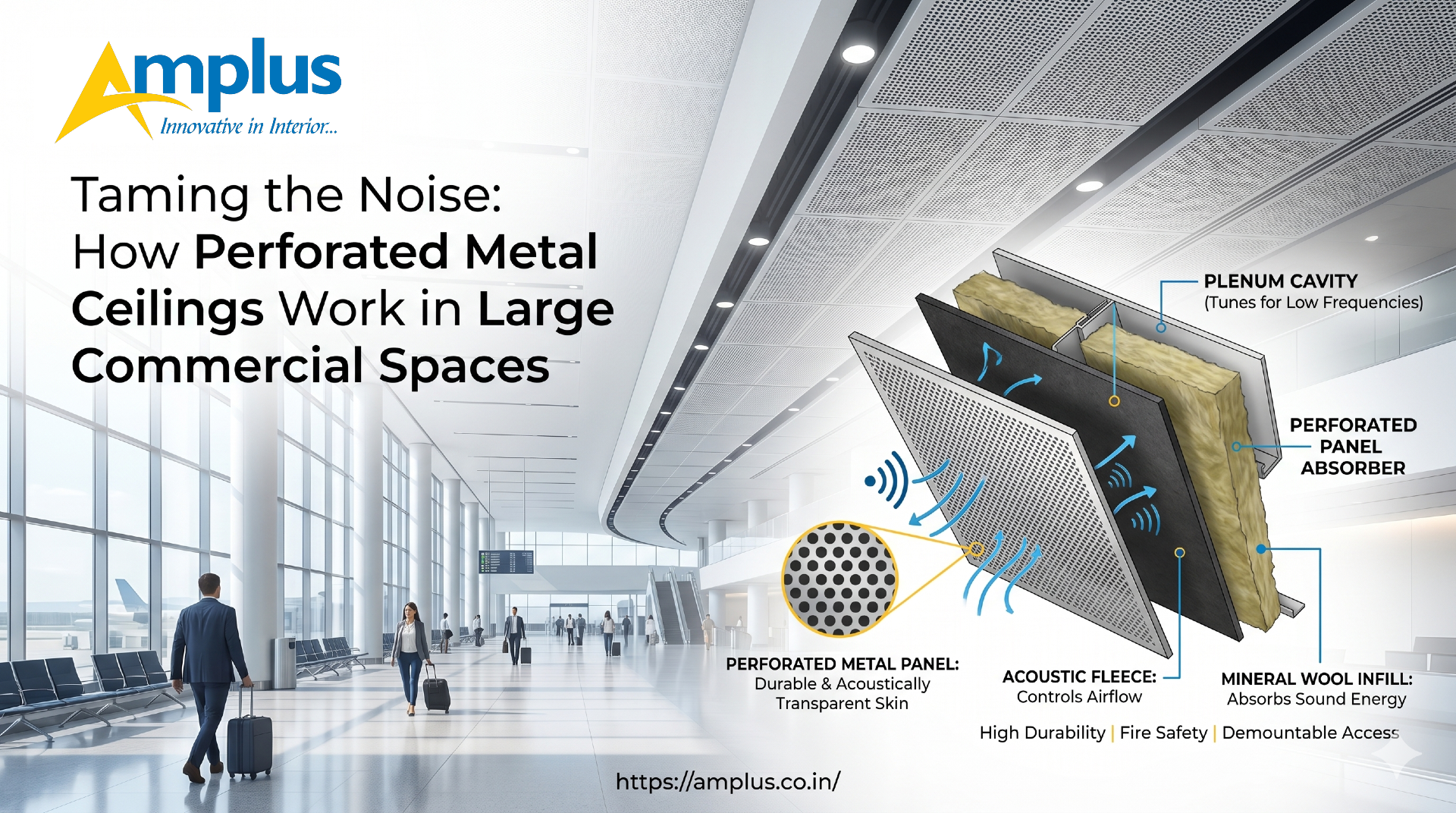
A perforated metal ceiling works as a perforated panel absorber. The metal face is punched with thousands of small holes, and sound passes through those holes into an absorptive layer behind the panel — usually an acoustic tissue or fleece bonded to the back, plus a pad of mineral wool or glass wool, sitting in front of the air cavity above. The sound energy enters, gets trapped and dissipated in the soft backing, and doesn’t come back. The metal you see is essentially a durable, decorative, acoustically transparent skin over the real absorber.
This is the single most important thing to understand: buy perforated metal without proper backing and you’ve bought decoration, not acoustics.
Open Area and Perforation Pattern
How much sound gets through to the absorber depends heavily on the open area — the percentage of the panel surface that’s actually holes. Larger or more closely spaced perforations mean a higher open area and generally broader sound absorption. Patterns vary from tiny, almost invisible micro-perforations to bold decorative grids, and the choice balances acoustic need against the look the architect wants. As a rough guide, more open area helps absorption, but it’s the combination of perforation, backing, and cavity that determines the result.
The Acoustic Backing
The infill behind the panel does the actual absorbing. An acoustic fleece controls airflow through the holes, while the mineral or glass wool pad converts sound energy into heat. Change the thickness and density of this backing and you change the performance — which is why two visually identical metal ceilings can perform completely differently.
Cavity Depth and Low-Frequency Control
The air gap between the panel and the structural slab — the plenum — matters more than most people expect, especially for lower frequencies. A deeper cavity improves absorption of bass and lower-mid sound, which is often the hardest part of the spectrum to control. By tuning hole size, backing, and cavity depth together, a system can be engineered to absorb across a target frequency range.
Performance is expressed as an NRC (Noise Reduction Coefficient) or a weighted absorption value, measured in a lab to recognised standards such as ISO 354 or ASTM C423 — and those tested figures, not the brochure photo, are what you should specify against.
Why Large Buildings Choose Perforated Metal?
Plenty of materials absorb sound. Perforated metal wins in large commercial settings for reasons beyond acoustics.
It’s durable — it stands up to the knocks, traffic, and decades of use those public buildings demand, where softer tiles would look tired fast. It’s non-combustible, which matters enormously for fire safety in large occupied spaces. It tolerates moisture and humidity far better than mineral fibre or gypsum, suiting transport hubs, pools, and washroom-adjacent zones. Most systems are demountable — hook-on or clip-in panels lift out for access to the services packed into the plenum above. It’s hygienic and cleanable, which is why healthcare and food environments favour it. And it offers real design freedom — large consistent spans, curves, custom perforations, and a premium architectural finish that ties a flagship building together.
In short, it does the acoustic job while also surviving the environment and looking the part. For large buildings, that combination is hard to beat.
Honest Limitations and Common Mistakes
No system is perfect, and being straight about this is part of getting it right.
The biggest mistake, by far, is specifying metal for looks and forgetting the backing. A low-open-area or unbacked metal ceiling can actually make a space more reverberant, not less — we’ve been called in to fix exactly this more than once. The acoustics live in the infill, so if it’s value-engineered out, the performance vanishes.
It’s also worth being clear that perforated metal ceilings provide absorption, not isolation. They reduce echo and noise build-up within a space; they do little to stop sound passing between floors. That’s a soundproofing job requiring mass and decoupling, which is a different system entirely.
Other realities: metal systems cost more upfront than mineral fibre ceiling tiles, they’re heavier so the suspension grid must be rated for the load, and in very large reverberant volumes like grand atriums, the ceiling alone may not be enough — you may need wall absorption or baffles as well to bring the space under control. None of these are dealbreakers; they’re just things to plan for honestly.
Conclusion
Large commercial buildings are acoustically unforgiving by nature — big volumes, hard surfaces, and constant noise. Perforated metal ceiling systems are one of the most effective and enduring answers, but only when they’re understood properly. The metal you see is a durable, beautiful skin; the acoustic work happens in the backing and the cavity behind it. Specify the full system by its tested numbers, keep the infill in the budget, remember the difference between absorbing and blocking sound, and treat the whole room in genuinely large volumes — and you get a ceiling that looks the part and quietly does its job for decades.
The buildings that sound calm and clear didn’t get that way by accident. They were engineered to, and the ceiling was a deliberate part of the plan.
Frequently Asked Questions
Does a perforated metal ceiling really absorb sound?
Yes, but only as a complete system. The perforations let sound pass through to an absorptive backing of acoustic fleece and mineral or glass wool behind the panel. Without that backing, the metal simply reflects sound.
What makes perforated metal good for large commercial buildings?
It combines sound absorption with durability, fire resistance, moisture tolerance, easy cleaning, and demountable access — all qualities large, high-traffic public buildings need. It also offers premium design flexibility across big spans.
How is the acoustic performance measured?
By the NRC (Noise Reduction Coefficient) or a weighted sound absorption value, tested in a lab to standards like ISO 354 or ASTM C423. Always specify against the tested figure for the full system, including the backing and cavity.
Do perforated metal ceilings block noise between floors?
No. They absorb sound and reduce echo within a space, but they don’t isolate sound between floors. Blocking sound transmission requires mass and decoupling, which is a separate soundproofing system.
Why does the percentage of open area matter?
The open area is the proportion of the panel that is perforations. It influences how much sound reaches the absorptive backing, so along with hole size, backing, and cavity depth, it shapes the overall absorption performance.
Are perforated metal ceilings worth the higher cost?
In demanding public spaces, often yes. The durability, fire and moisture performance, hygiene, and long service life make them cost-effective over time, even though they’re more expensive upfront than mineral fibre tiles.
Can perforated metal ceilings control low-frequency noise?
To a degree, yes — by using a deeper air cavity behind the panel and the right backing, the system can be tuned to absorb lower frequencies, which are usually the hardest part of the spectrum to manage.